
"Officer" - Light Armored Train VSYUR
Bronepoezd (Armored Train)
White Forces South of Russia
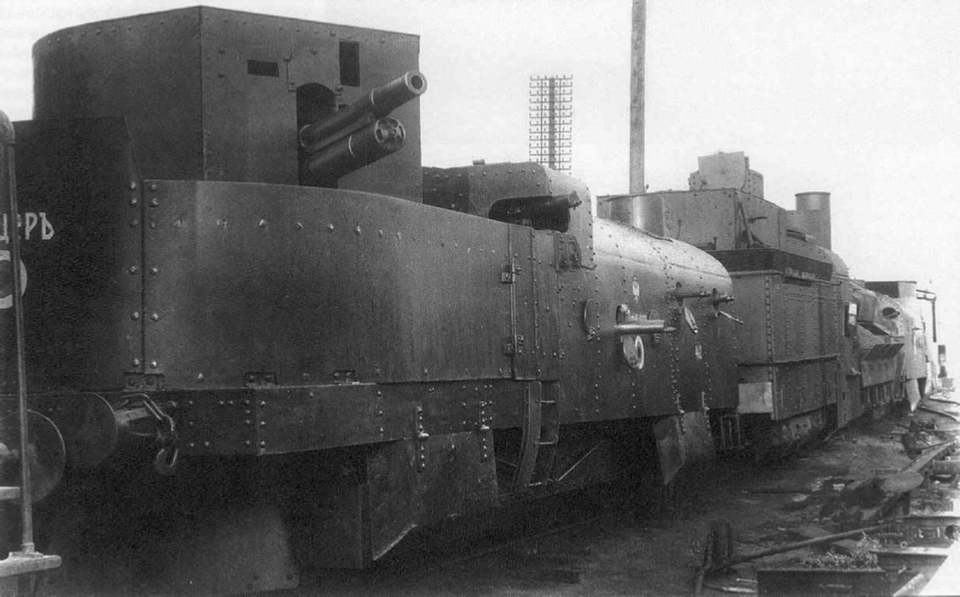
Light armored train of the Armed Forces of the South of Russia "Officer" before being sent to the front from Rostov-
‘Officer’ (‘An Officer’)
After the capture of Yekaterinodar by the Volunteer Army on August 3, 1918, while retreating to Novorossiysk, the Red Army blew up the bridge across the Kuban, and the white armored trains could not take part in the pursuit of the enemy. Thus, from the armored platforms left by the Reds on the left bank of the Kuban, on August 7, an urgent formation of a new light armored train, which later received the name "Officer", began. Initially, it consisted of one open platform with a 3-
After 2 days, on August 9, in its first battle at the Abinskaya station, the armored train recaptured another closed area with small-
After another 2 days, the headquarters of the Red Army was destroyed by an armored train at the Tunnelnaya station when moving to Novorossiysk, and after another 2 days it was the first to enter Novorossiysk, where 2 more red armored trains were captured.
The name "Officer", the armored train was assigned on August 16, 1918 (according to other sources, in November 1918 ).
In late August -
After the capture of Armavir on September 3 -
On September 10, instead of the dead "1st Armored Train", "Officer" moved to the more important at that time direction Armavir -
The "Officer" came out of repair at the end of October 1918, consisting of two machine-
On October 31, in a battle at the Palagiada station, a steam pipe was broken on an armored locomotive, and the steam pressure in the locomotive's boiler began to drop rapidly. The "officer" barely managed to leave the station in the direction of Ryzdvyaya.
Where did the armored train go after the capture of Stavropol, and there is little information about its actions in 1919. On March 30, 1919, in the battle at the Khacepetovka station, the "Officer" armored train captured the red "2nd Siberian armored train", named in the Volunteer Army in gratitude for its appearance by the name "Glory to the Officer".
On the night of September 20, 1919, "Officer" together with "United Russia" suddenly seized the Kursk station and the city railway station, after which the city was hastily abandoned by the Reds. In October 1919, the "Officer" took part in the assault on Orel together with the heavy armored train "Ioann Kalita". At this time, 3 three-
Until February 27, 1920, the "Officer" armored train was in Yekaterinodar to guard the Headquarters and the commander-
Later, another armored train named "Officer" was formed in the Crimea on the basis of the armored train "Slava Kubani". It is not known whether the personnel and weapons of the "Officer" left near Novorossiysk took part in its formation. The last mention of this armored train found so far refers to the battles of October 1920.
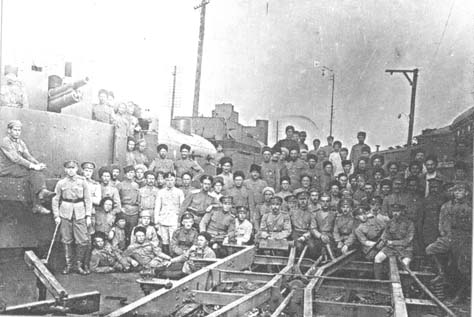
"Officer" armored train and armored train crew at Rostov-
‘Officer’ (‘Glory to the Officer’)
Another armored train named "Officer" is often confused with this armored train. The other armored train is more technically called the "Glory to the Officer" and was formed in the Crimea on the basis of the armored train "Slava Kubani". When its name is shortened to “Officer” it becomes confusing.
