
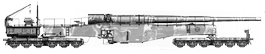
‘Dmitry Donskoy’ - Armored train
Also Called ‘The Sea’ Armored Train
Before August 11, 1918 it was called the “Marine Battery No. 2” Bronepoezd (Armored Train)
Before approximately September, 1919 it was called the "Marine" Bronepoezd (Armored Train)
Finally named the ‘Dmitry Donskoy’ Bronepoezd (Armored Train)
White Forces South of Russia

Dmitry Donskoy" ("Marine Battery No. 2", "Marine" armored train, “Sea” armored train)
"... In Yekaterinodar, the formation of a new armored train called" Marine Battery No. 2 "(later the light armored train" Dmitry Donskoy ") began on August 11. 47mm gun, and one landing car. The commander of the "Marine Battery" was appointed Captain 2nd Rank Markov. The personnel of the "Marine Battery" was formed mainly of naval officers and aviation officers who served machine guns.
The materiel was in poor condition due to the negligence of the Reds. The stock of shells was very limited, and one could count on replenishing it only by capturing shells from the enemy. The casings had to be reloaded several times, and from this came the spells. It was difficult to eliminate the spells, because at that time there were no mobile artillery workshops in the Volunteer Army ... "
This is how A.A. Vlasov history of the creation of this armored train. In the second half of August, he took part in the attack on Armavir from the side of the Kavkazskaya station. After the capture of Armavir by the Volunteer Army on September 3 -
When the Taman army entered Armavir on September 13, the "reserve" of the 1st "Marine Battery" was withdrawn along Tuapseinka to Stavropol, and the armored train itself fought back to Stavropol for the next month and a half, holding back the Taman offensive.
Senior Lieutenant Makarov was appointed commander, and the combat strength was reinforced with an armored platform with a naval 100 mm gun.
On October 14, in a battle at the crossing, the Base "Sea" armored train was ambushed, derailed and abandoned by the team. Makarov was mortally wounded (see the description of this battle). Later, the armored train was repulsed by the troops of General Wrangel from the Reds at the station in Stavropol.
Subsequently, the Marine armored train under the command of Colonel Maralin fought in the Black Earth Region and in the Ukraine, where it received the name "Dmitry Donskoy". In September 1919, the armored train was located near Kursk. In November 1919, "Dmitry Donskoy", then operating on the Kharkov-
The armored train "Dmitry Donskoy" went through the Civil War to the very end, and was left in Kerch, in November 1920, during the evacuation of the last white units.
However, the old combat unit of "Dmitry Donskoy" was not abandoned, and even survived the new composition. The Dmitry Donskoy armored platform, which had exhausted its resource in gun barrels and undercarriage, and was previously decommissioned, became part of the For Holy Rus armored train hastily created during the retreat in early 1920 and ended its combat path near Novorossiysk on March 13, 1920.
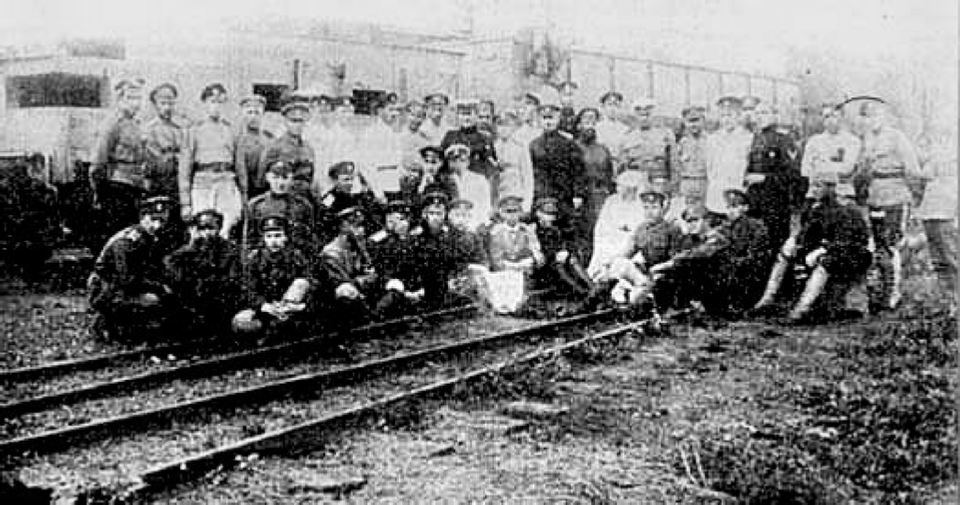
The crew of the Dmitry Donskoy armored train pictured faintly in the background, taken at Kursk on September 1919.
The Red Offfensive
The offensive of the Reds to Stavropol began in the first half of October 1918.
The naval armored train was at the disposal of the head of the 3rd division, General Drozdovsky. The "reserve" of the armored train, that is, the carriages adapted for housing, were left at the Stavropol station. The warhead operated along the Stavropol-
The Marine armored train located near the Nedremennaya station supported with its artillery fire parts of our Plastun brigade, which were forced to withdraw. About half of the available 75 mm was used up. m 47 mm. shells. On the morning of October 13, the Marine armored train entered the position occupied by units of the 2nd Officer Regiment near the Tatarka station... The day passed calmly, but by evening information was received about a deep detour by the Reds of our left flank in the direction of Stavropol. At 8 o'clock. In the evening, with the permission of General Drozdovsky, the Marine armored train set off to supply water to the Stavropol station. There he was to await a battle order. If the order was not received, in the absence of changes in the situation, the armored train had to return to its old position at the Tatarka station by dawn.
At 2 am on October 14, the Marine armored train , having received no new orders, left Stavropol for a position. On the way, he was fired at by machine-
Later it turned out that these were the Soviet 1st and 3rd Taman regiments. Machine-
The team began to suffer heavy losses. Red cavalry rode out to her flank, treacherously putting on shoulder straps and distinctive white corners on their caps. Therefore, they were admitted to a close distance. To the demand to surrender, the ranks of the Marine Armored Train responded by shooting. Several horsemen were killed, and the rest scattered. The retreat with battle continued at a distance of about 2 versts. Then the chains of the red stopped chasingso as not to expose your flank to the units of the 2nd Officer Regiment. During the abandonment of the armored train and the departure of 42 ranks of the armored train team, 18 people were killed. and 5 people were wounded. In addition to the previously named officers, the following were killed: Staff Captain Prince. Shakhovskoy, warrant officers Zavadovsky and Khrushchev, warrant officers of the fleet Polyakov, Lysenko and Berezovsky, military pilot Lieutenant Gavrilov. After emerging from the fire of the Reds, the wounded ranks of the team were arranged on requisitioned carts. The team of the Marine Armored Train arrived in Stavropol, and at about 4 o'clock. In the afternoon, the composition of the "reserve" of the armored train, overcrowded with our wounded and civilian refugees, departed in the direction of the Kavkazskaya station. Stavropol was taken by the Reds on October 17 ...During the abandonment of the armored train and the departure of 42 ranks of the armored train team, 18 people were killed. and 5 people were wounded. In addition to the previously named officers, the following were killed: Staff Captain Prince. Shakhovskoy, warrant officers Zavadovsky and Khrushchev, warrant officers of the fleet Polyakov, Lysenko and Berezovsky, military pilot Lieutenant Gavrilov.
After emerging from the fire of the Reds, the wounded ranks of the team were arranged on requisitioned carts. The team of the Marine Armored Train arrived in Stavropol, and at about 4 o'clock. In the afternoon the composition of the "reserve" of the armored train, overcrowded with our wounded and civilian refugees, departed in the direction of the Kavkazskaya station. Stavropol was taken by the Reds on October 17 ...During the abandonment of the armored train and the departure of 42 ranks of the armored train team, 18 people were killed. and 5 people were wounded. In addition to the previously named officers, the following were killed: Staff Captain Prince. Shakhovskoy, warrant officers Zavadovsky and Khrushchev, warrant officers of the fleet Polyakov, Lysenko and Berezovsky, military pilot Lieutenant Gavrilov. After emerging from the fire of the Reds, the wounded ranks of the team were arranged on requisitioned carts.
The team of the Marine Armored Train arrived in Stavropol, and at about 4 o'clock. In the afternoon the composition of the "reserve" of the armored train, overcrowded with our wounded and civilian refugees, departed in the direction of the Kavkazskaya station. Stavropol was taken by the Reds on October 17 ...military pilot Lieutenant Gavrilov. After emerging from the fire of the Reds, the wounded ranks of the team were arranged on requisitioned carts. The team of the Marine Armored Train arrived in Stavropol, and at about 4 o'clock. In the afternoon, the composition of the "reserve" of the armored train, overcrowded with our wounded and civilian refugees, departed in the direction of the Kavkazskaya station. Stavropol was taken by the Reds on October 17 ...military pilot Lieutenant Gavrilov. After emerging from the fire of the Reds, the wounded ranks of the team were arranged on requisitioned carts. The team of the Marine Armored Train arrived in Stavropol, and at about 4 o'clock. In the afternoon, the composition of the "reserve" of the armored train, overcrowded with our wounded and civilian refugees, departed in the direction of the Kavkazskaya station. Stavropol was taken by the Reds on October 17 ...
Meanwhile, while the Marine Armored Train and General Drozdovsky's units were defending Stavropol, the 1st Kuban Rifle Regiment and Plastun battalions from the north were attacking Armavir. On October 13, Armavir was again taken by the Volunteer Army.